
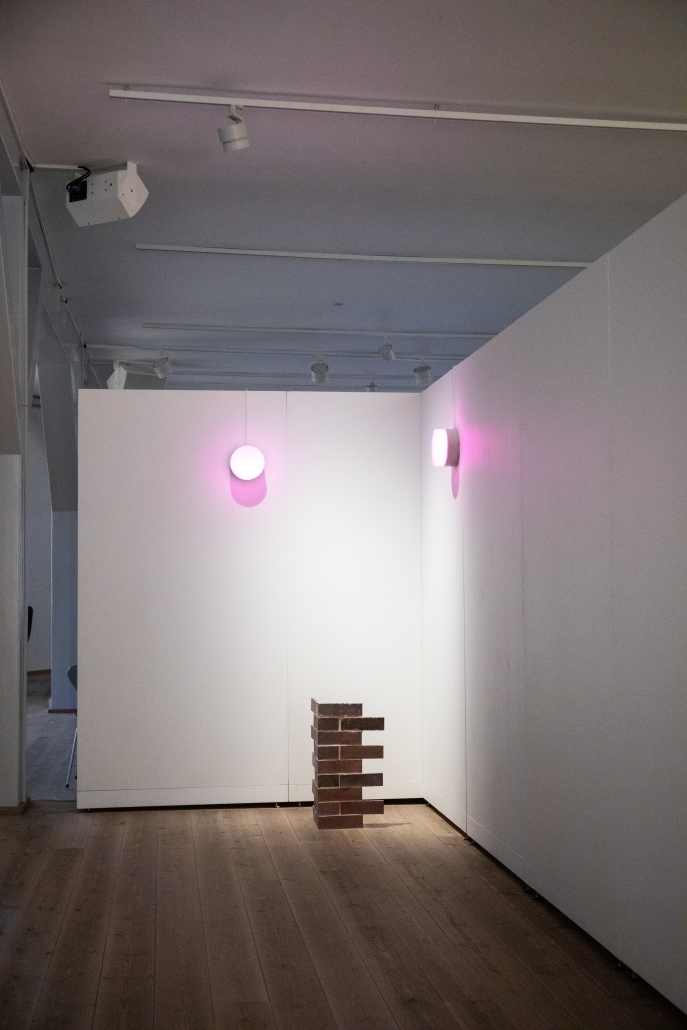
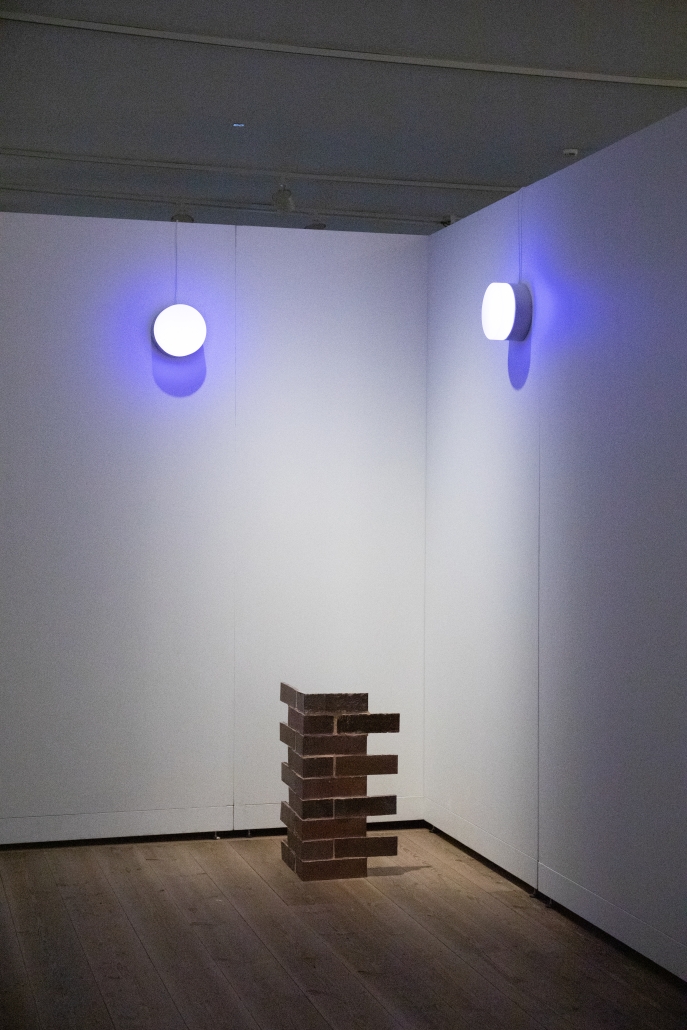
Bricks and mortar, Otto-Weidt-Platz
Modular thin bricks (Klinkerriemchen), mortar, 2021
Exhibited at Maxi Reload in Unknown Depth, The Library Hall at Rundetaarn (The Round Tower), Copenhagen (2021–2022).
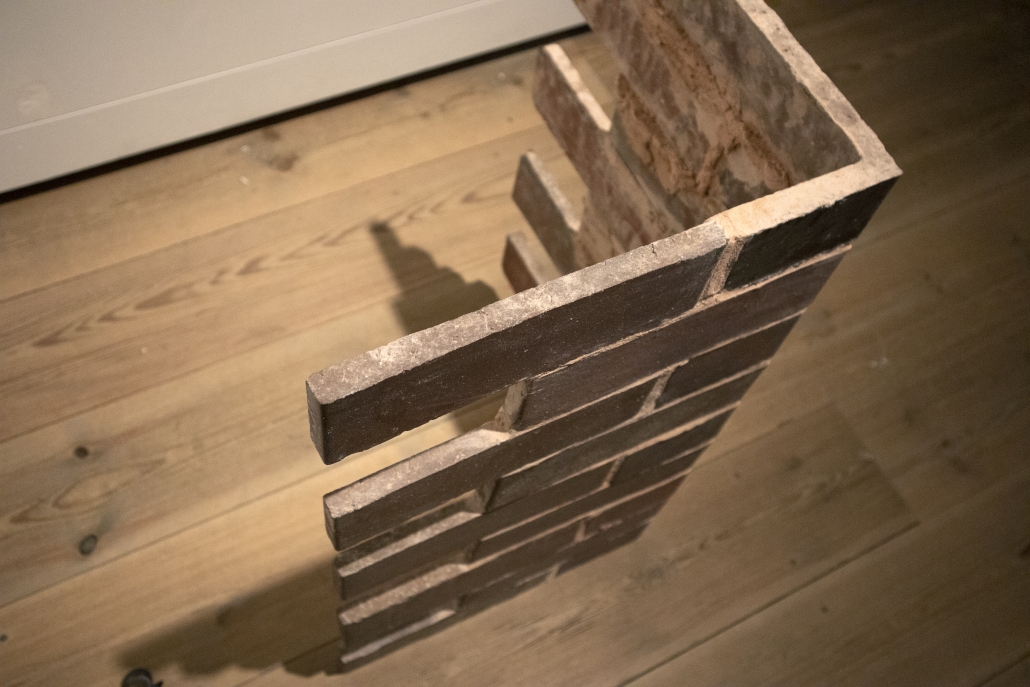
Under mit residency på ZK/U (Zentrum für Kunst und Urbanistik) i Berlin brugte jeg meget tid på at vandre rundt og undersøge, hvordan lokalområdet var ved at forandre sig. På byggepladsen ved Otto-Weidt-Platz – midt i overgangsfasen mellem nedrivning og nybyggeri – fandt jeg disse overskydende murstensskaller. Pladsen udgør hjertet i Quartier Heidestrasse og Europacity, et 61 hektar stort, primært privatfinansieret byudviklingsområde nord for Berlin Hauptbahnhof, hvor omkring 3.000 nye lejligheder og kontorer skyder op.
Da jeg konstruerede væggen i værket, satte jeg skallerne sammen med en lys, rødlig mørtel for at give skulpturen en fysisk og sanselig tilstedeværelse, der relaterer til kroppen. Med værket ønsker jeg samtidig at tydeliggøre, hvordan byggemetoden her peger langt ud over Berlin. Brugen af tynde murstensskaller (Klinkerriemchen) – limet direkte uden på tykke lag mineraluld og rå beton (WDVS-systemer) eller indstøbt i præfabrikerede betonelementer – er et fænomen, der går igen i nybyggeri over hele Europa. Skallerne skaber en hurtig overflade af klassisk murstenshåndværk uden på strømlinet, investorstyret arkitektur. På den måde bliver skulpturen et symbol på netop denne måde at bygge og udvikle byer på i dag – et tema, der også dannede rammen, da værket blev vist på duoudstillingen Maxi Reload in Unknown Depth i Rundetårns Bibliotekssal.
MAXI RELOAD IN UNKNOWN DEPTH
The exhibition “Maxi Reload in Unknown Depth” is about the love-hate relationship to the age we are living in and the unknown world we are entering. The artists Clara Black Starck and Kristine Hymøller occupy the Round Tower’s Library Hall with sculptures and objects that reflect their ambivalent relationship to innovation, architecture, machines, and technology.
The works of Clara Black Starck and Kristine Hymøller examine the urban infrastructure in a broad sense as a connection and a communication between points of the city, buildings, and people. The works are juxtaposed in order to create a dialogue between the artists’ individual and common interpretation of the persistent acceleration of the Third and Fourth Industrial Ages with the Library Hall as the setting for a narrative about the development of our society.
Bricks and mortar, Otto-Weidt-Platz
Modular thin bricks (Klinkerriemchen), mortar, 2021
Exhibited at Maxi Reload in Unknown Depth, The Library Hall at Rundetaarn (The Round Tower), Copenhagen (2021–2022)
During my residency at ZK/U (Center for Art and Urbanistics) in Berlin, I spent a lot of time walking through the neighborhood, researching how the area was transforming. On the construction site at Otto-Weidt-Platz—caught in the transition between demolition and new construction—I found these leftover thin bricks. The square sits at the heart of Quartier Heidestrasse and Europacity, a 61-hectare, predominantly privately funded urban development north of Berlin Central Station where around 3,000 new apartments and office spaces are taking shape.
When constructing the wall for the piece, I joined the bricks together using a pale, reddish mortar to give the sculpture a physical, tactile presence related to the human body. At the same time, with this work, I want to highlight how the construction method here extends far beyond Berlin. Using thin brick slips (Klinkerriemchen)—adhered directly onto thick layers of mineral wool and raw concrete (ETICS/WDVS systems) or cast into prefabricated concrete panels—is a widespread phenomenon in new developments across Europe. The slips create a quick veneer of traditional masonry over standardized, investor-driven architecture. In this way, the sculpture becomes a symbol of this exact approach to building and reshaping cities today—a theme central to its presentation in the duo exhibition Maxi Reload in Unknown Depth in the Library Hall at Rundetaarn.
MAXI RELOAD IN UNKNOWN DEPTH
The exhibition “Maxi Reload in Unknown Depth” is about the love-hate relationship to the age we are living in and the unknown world we are entering. The artists Clara Black Starck and Kristine Hymøller occupy the Round Tower’s Library Hall with sculptures and objects that reflect their ambivalent relationship to innovation, architecture, machines, and technology.
The works of Clara Black Starck and Kristine Hymøller examine the urban infrastructure in a broad sense as a connection and a communication between points of the city, buildings, and people. The works are juxtaposed in order to create a dialogue between the artists’ individual and common interpretation of the persistent acceleration of the Third and Fourth Industrial Ages with the Library Hall as the setting for a narrative about the development of our society.

